4them.life

For them. For always.

A companion that calls you and gathers your memories…
and turns them into a family treasure, kept forever.

4Them, because these stories belong to the people you love. .Life, because they deserve to stay alive, untouched, for as long as your family does.
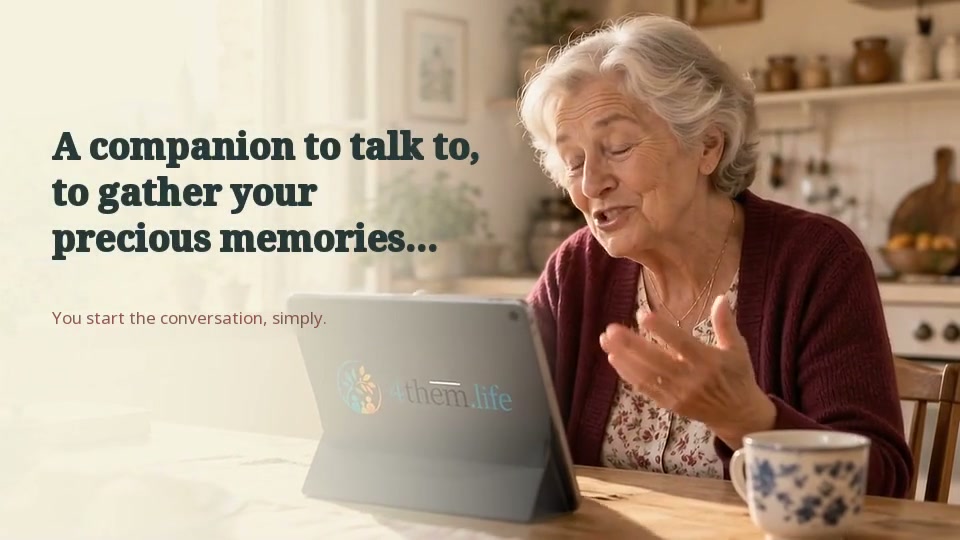
Vidéo de présentation montrant le compagnon 4Them.Life qui appelle une personne pour recueillir ses souvenirs
Thinking of a loved one rather than yourself?Visit the page made for families →
We are looking for families to try 4Them.Life — completely free during this phase.Join the private test →

Recording your parents’ memories: the most precious are also the most fragile.

We always think there will be time to ask dad, mum, grandma what their childhood was like, their first love, their working days. Then time passes. The photos stay, but the voices, the small details, the reason behind a look — they fade.

Today’s tools would ask you to type, to click, to remember a password. That is simply too much — and it’s not up to you to adapt to them.

How it works

Four steps to a family life story. Nothing new to learn.

01

You get a real call, by phone or on WhatsApp.

No app to install. No password. Your phone rings, or a WhatsApp message arrives, just like always. A patient AI companion speaks, listens, and waits until you have truly finished — no beep, no rigid automated menu, a voice that genuinely takes the time to hear you.

02

A natural, caring conversation begins.

One question at a time, at your own pace. The companion listens, gently asks for more, and respects the subjects you would rather leave aside.

03

Your memories are gathered and safely organised.

Every conversation is summarised and stored. Nothing is lost. Nothing is shared without your consent.

04

The book arrives on WhatsApp — and comes alive in your space.

A simple message like “send me my book” is enough. You receive the PDF as an attachment. In your personal space, you’ll also find the living magazine and your family tree, ready to browse whenever you like.

WhatsApp, beyond the call

The conversation continues whenever you feel like it.

No need to wait for Tuesday’s call. At any moment, you can send a photo, a snapshot of an old letter, or a voice note. The companion looks, reads or listens, and picks the story back up exactly where it stopped.

Aunt AïchaConversation with your companion
Photo — my wedding day. Look what I just found. What a beautiful photo. Who are the people standing next to you? On my right, my sister. Behind us, the whole family, there for the wedding day. Thank you. I’ll keep the picture alongside this memory.

A photo, and a question that matters

Aunt Aïcha sends an old black-and-white photo from her wedding day. The companion looks at it and replies: “What a beautiful photo. Who are the people standing next to you?” She tells the story. The picture is kept alongside the memory.

A letter found in a drawer

Dad comes across a handwritten letter from his own father. He takes a picture of it. The companion reads it, then asks: “He mentions his job back then. Do you remember what he did?” And the conversation starts again.

A spontaneous voice note, when typing is too much

Mum comes home late, sits down on the sofa and records a voice note. She talks about her day, a scent that brought back her childhood. The companion listens, sums it up, and asks the next question at just the right moment.

Photos, captioned at last

Those photos sleeping in a drawer deserve a caption.

One day we find them, at the bottom of a box: old photos full of faces. But no one remembers who is in them, when, where, or why. Without a caption, a photo loses all its meaning within a single generation.

And sometimes it is not just photos: a letter, an object, a paper slipped into the back of a box. The companion helps make sense of it — gently, without guilt — so you can decide together what is worth keeping and telling.

Tiroir de souvenirs de famille : photos anciennes et lettres conservées par 4Them.Life

01

Simply send the photo

By WhatsApp, straight from your phone. Or through the family sharing link, if a relative is the one who found it at home. No account, no app.

02

The companion analyzes it, then asks you 2-3 questions

Who is in this photo? Roughly when, and where? A little story tied to that moment? A few simple questions, asked gently, during a next conversation.

03

A caption is kept forever

In your own words, warmly rephrased. Photo and caption stay together, visible in your personal space and in the family link.

You are always the one who identifies. Never a machine.

No automatic facial recognition. You — and only you — say who is in the photo, with your own memories, words and truth. That is how we make sure what is passed on is authentic.

Grandma’s photo box

While clearing the attic, Karim finds an old box full of his grandmother’s photos. He sends the most mysterious ones through the family link. On the next call, the companion shows them to her one by one: “This one was the day we arrived in Marseille, in 1962…” Every photo goes back with its story, written in her voice.

The family can take part

A question from the family, asked in the companion’s voice.

Example

“How did grandma and grandpa meet?”

Lilas receives her grandmother’s private sharing link. She has always wondered how her grandparents met. She simply writes the question in the link — no account to create, no app to install.

A few days later, during the usual call, the companion says to her grandmother: “Your family was wondering how you met your husband… You’ve told me a little already, but I’d love to hear the story in your own words.”

The question comes up naturally, as if the companion had thought of it. Grandma tells the story, Lilas discovers it, and the memory is kept forever.

How it works

  • The family receives the private link already shared — the one that opens the memories and the transcripts.

  • They write a question they would love to hear asked: a recipe, a first meeting, a turning point, a value passed on.

  • The companion weaves it into the next conversation, in its own words, mentioning that the family was wondering about it.

No account for the family, no app to download. Just the link they already have. It’s a simple way to bring the people asking closer to the person telling.

Beyond photos

A companion to sort, keep and pass on — with meaning.

Many families have drawers, boxes or attics full of objects, papers and photos. The companion does more than listen: when you show it something, it helps you understand what it is, why it matters — and whether it is worth keeping and passing on, or letting go of with a clear mind.

We sort together

A photo, a letter, an old paper: the companion asks a few simple questions to understand the story. No judgment, no pressure.

We find the meaning before keeping

What matters is not keeping everything. It is knowing why we keep it. The companion helps put words to what has value.

We decide together what is passed on

Every important object or photo leaves with its caption, date and context — ready to be shared with the family when the time is right.

This is not decluttering. It is memory sorted by hand, with gentleness and clarity.

In your personal space

A book, and more: memories that stay alive.

The PDF book remains the precious object to print and give. But in your space, two companions extend it — readable anytime, enriched with every new conversation.

My magazine

A story that recompiles itself on demand from everything you have shared, with a warm dashboard — conversations held, themes explored, eras revisited — and a true narrative to reread whenever you like. The book stays the book; the magazine is its living version.

My tree

The people who matter, gathered around you, each with the number of memories tied to them. Nothing complicated to fill in: names spotted in your photos are suggested automatically, and a single click adds them.

What makes us different

Built for the person telling the story, and for those who receive it.

A call that truly waits for the answer.

No awkward beep, no cutting off mid-sentence. The companion speaks, falls silent, and picks up again once the person has finished — like a real phone conversation.

WhatsApp, even between calls.

You send a photo, a letter or a voice note whenever the urge comes. The companion looks, reads or listens, and carries the story on from there.

A real conversation, not a form.

No boxes to tick. We talk, we listen, and we come back to a detail whenever the story asks to be told.

Respect above everything.

Sensitive subjects are approached with great care. We slow down, we let silence happen, and we always leave a way out.

Several languages, one same voice.

French, English, Arabic. The conversation happens in your language — the one of the heart.

Private and secure.

What is shared stays between you. No advertising, no data resold, no surprises.

A life book for those who want their story to live on.

Whether your family lives next door or on the other side of the world, 4Them.Life helps you gather, preserve and pass on your memories — simply, humanly, forever.

Frequently asked questions

How long does a conversation last?

Usually 10 to 15 minutes. You can stop whenever you like and continue later: the companion remembers everything.

Do I need to be good with computers?

No. Everything happens by phone or WhatsApp, like an ordinary conversation. Nothing to install.

Who can read these memories?

The person interviewed, and the loved ones they choose to share a link with. Nothing is public.

Which languages?

French, English and Arabic, including dialects.

What do you get in the end?

A book and a magazine to download, with family photos and a timeline of the big moments.

How much does it cost?

The first issue of the family magazine is free, with no commitment.

Give your family what time will never give back.